Video Bokep Ariel Dan Donita

BASIC
ELECTRONICS COURSE

THE SCHMITT TRIGGER

Page 49 Video Bokep Ariel Dan Donita INDEX

Video Bokep Ariel Dan Donita

One of the most universal chips is the Hex Schmitt Trigger, known as the 74C14. It is also marketed as 40106, 40014, and 74HC14. These are CMOS chips and are characterised by low current consumption, high input impedance and a supply voltage from 5v to 15v. (Do not substitute 7414 or  74LS14. They are TTL chips and operate on 4.5v to 5.5v and have low impedance inputs.)

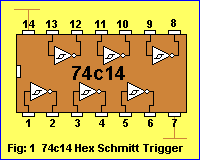
Fig: 1 shows the six Schmitt gates in a 74c14 chip. 

Video Bokep Ariel Dan Donita   Video Bokep Ariel Dan Donita

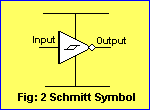
Fig: 2 shows the symbol for a single input Schmitt Trigger Inverter with power rails: 

Video Bokep Ariel Dan Donita

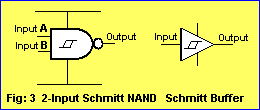
Fig 3 shows the Schmitt Trigger characteristic incorporated into other gates:

Video Bokep Ariel Dan Donita

We will concentrate on the single-input Schmitt Trigger gate as contained in the 74c14 IC. 
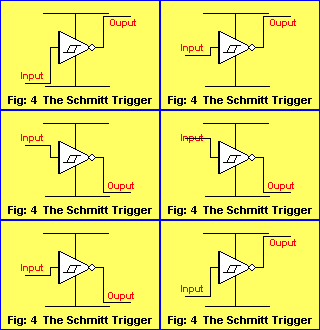
Fig: 4 shows the Schmitt Trigger Characteristic:  

Video Bokep Ariel Dan Donita

The output is HIGH until the input rises to 66% of rail voltage. 
The output goes LOW when the input goes above 66%.
The output remains HIGH until the input fall to 33%. 

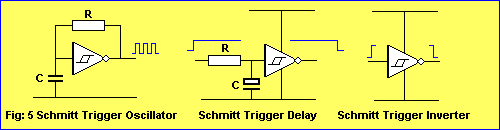
A Schmitt Trigger gate can be wired as an oscillator, delay, inverter (and other functions, depending on the surrounding components). 
Fig: 5 shows the Schmitt Trigger wired as an oscillatordelay and inverter:

Video Bokep Ariel Dan Donita

Each of the 6 gates in the 74c14 can be used to create a separate "building block" and this gives the chip a wide range of capabilities. 
THE FREQUENCY OF AN OSCILLATOR
When a capacitor and resistor are added to a Schmitt Trigger gate, as shown in the first circuit 
of Fig: 5 above, the result is an oscillator called a MULTIVIBRATOR. A multivibrator has the feature of producing a square wave and this waveshape can have equal high and low periods (called 50:50 mark:space ratio) or any ratio of high and low periods. The HIGH period is called the MARK and the LOW is called the SPACE
The frequency of an oscillator depends on the value of R and C. There is no fixed "ratio" for these components however it is best to refer to sample circuits to see the values needed for a particular frequency - otherwise you may arrive at "unusual" combinations such as very large capacitors and very small resistors to achieve a high frequency. 
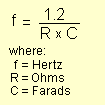
The frequency of a Schmitt oscillator is determined by the following equation: 
    Video Bokep Ariel Dan Donita
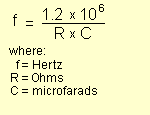
An easier equation to work with is:
Video Bokep Ariel Dan Donita
Oscillator circuits for the 74c14 can be separated into three categories:
1. Low frequency
2. Medium frequency, and
3. High frequency
Low frequency oscillators are below 1Hz and can also be classified as DELAY circuits or TIMING circuits. 
Medium frequency oscillators range from 1Hz to about 500kHz. 
High frequency oscillators are above 500kHz. 
We separate circuits into three categories due to the value of capacitor needed. 
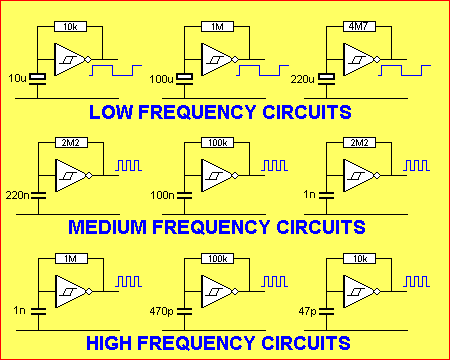
For low frequency oscillators the capacitor is an electrolytic, ranging from 1u to 220u.
For medium frequency circuits the capacitor is a ceramic 1n to 100n
For high frequency circuits the capacitor is a ceramic 47p to 1n
The value of R should be in the range 10k to 4M7 in all cases. 
The maximum frequency for a particular chip will depend on the supply voltage and the type of chip. 
Some chips do not like supply voltages below 5v (maximum supply voltage is 15v for all chips in this discussion) while other chips (HS) are especially made for high speed operation. All chips will operate up to 500kHz with a 5v to 12v supply. Requirements outside this range will need special investigation. Some chips are designed to operate down to 2-3v.
  
Fig: 6 shows sample oscillator circuits with approximate values for R and C.
 

Video Bokep Ariel Dan Donita
Fig: 6 Low, Medium and High frequency Schmitt Trigger Oscillators

 
FREQUENCY CALCULATORS

Video Bokep Ariel Dan Donita -

Jika yang Anda maksud adalah ulasan film/klip dewasa yang sah dan konsensual, saya bisa membantu dengan alternatif aman seperti:

The rise of popular Indonesian videos has democratized the entertainment industry. Talent is no longer concentrated solely in the capital city of Jakarta. Creators from Sumatra, Sulawesi, and East Java are finding national fame by showcasing their regional identities. This shift has fostered greater cultural representation and pride among viewers.

Indonesia’s oral traditions provide the foundation for many popular videos and local entertainment. The Story of Malin Kundang Video Bokep Ariel Dan Donita

Jika suatu saat benar ada pihak yang memalsukan video deepfake menggunakan wajah Ariel Tatum atau Donita, mereka dapat menggunakan:

Indonesia is experiencing a massive digital renaissance. With over 200 million internet users, the archipelago has become one of the world's largest consumers of online media. From viral TikTok dances in Jakarta to cinematic vlogs in Bali, Indonesian entertainment and popular videos are reshaping global digital culture. Jika yang Anda maksud adalah ulasan film/klip dewasa

Then there is the silent genre. Videos of pentol (meatballs) being squeezed in boiling water, martabak being slathered with chocolate sprinkles, and es doger being scraped. These videos have no host, no voice, just the krincing (clinking) of a metal spatula. They are therapy for the urban homesick Indonesian.

Indonesia has a deep cultural fascination with the supernatural. Reality-style horror investigations, ghost-hunting vlogs, and storytelling videos about local urban legends (like Kuntilanak or Pocong ) consistently rank among the top trending videos. Horas and Regional Pride This shift has fostered greater cultural representation and

The spectrum of popular Indonesian videos is vast, catering to a wide range of tastes and demographics. Several distinct categories consistently top the trending charts: 1. Comedy and Everyday Vlogs (Sketsa Komedi)

The global entertainment landscape is experiencing a massive shift, and Indonesia is at the forefront of this digital revolution. As the world's fourth most populous nation, with a highly tech-savvy and young demographic, Indonesia has transformed into a powerhouse for digital content creation. The phrase "Indonesian entertainment and popular videos" captures a vibrant, rapidly evolving ecosystem where traditional cultural elements seamlessly blend with modern digital formats.

Independent production houses create high-quality romantic comedies and dramas directly for YouTube, bypassing traditional TV networks.

Popular videos on YouTube have also given rise to indie filmmakers. Channels like Kok Bisa? (an educational channel) and Rans Entertainment (family vlogging) pull in hundreds of millions of views. These aren't just random clips; they are highly produced, serialized video products that compete directly with major studios.


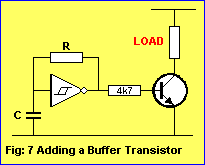
Each gate of a 74c14 is capable of delivering up to 20mA with a 12v supply, 15mA with a 9v supply and 10mA with a 5v supply. A buffer transistor can be used to increase the output current if needed. 
Fig: 7 shows how a buffer transistor is connected to the output of a gate:

Video Bokep Ariel Dan Donita

The voltage and current (called the "supply") for the 6 gates in a 74c14 comes from pin 14. The ground pin for the chip is pin 7. Each gate on a circuit diagram is normally shown without the power rails. It is understood they are present.
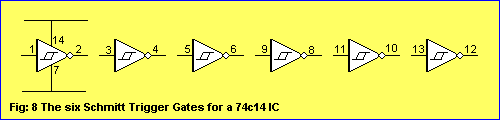
Fig: 8 shows the power rails for a 74c14 and the individual gates:
 

Video Bokep Ariel Dan Donita

HOW A GATE WORKS
The next diagram (it is a repeat of Fig: 4 above) shows how the output of a Schmitt gate jumps from HIGH-to-LOW and LOW-to-HIGH as the input voltage rises and falls:

Video Bokep Ariel Dan Donita

The output of a Schmitt Trigger gate is the opposite of the input. When the input is LOW, the output is HIGH.
As the input rises to 66% of rail voltage, the output instantly goes LOW and the input has to fall to 33% of rail voltage for the output to go HIGH. 
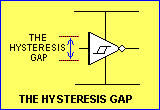
The gap between 33% and 66% is called the HYSTERESIS GAP and this has been specially designed so that the input does not detect small fluctuations.

Video Bokep Ariel Dan Donita

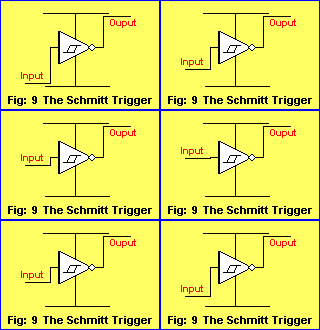
Fig: 9 shows a voltage being applied to the Schmitt gate. The voltage is 55% of rail and this is not sufficient to change the output: 

Video Bokep Ariel Dan Donita

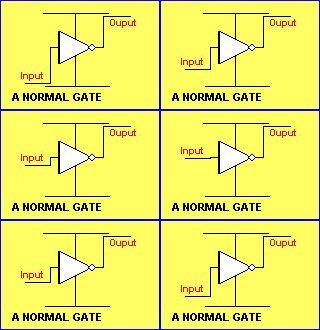
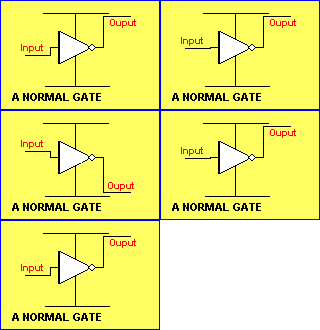
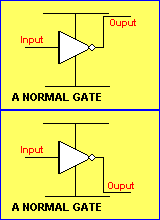
The following figure shows a normal gates. It changes when the input rises above about 53% of rail voltage and changes back when the input falls below 47%.

 Video Bokep Ariel Dan Donita 

The following diagram shows the very small gap for a normal chip, where the output jumps from HIGH-to-LOW in an uncontrolled manner:

 Video Bokep Ariel Dan Donita

Here's the secret of a Schmitt gate: Any noise (up to 60%) entering a Schmitt Trigger will not alter the condition of the gate. Any noise up to 55% entering a normal gate will change the output:

Video Bokep Ariel Dan Donita  Video Bokep Ariel Dan Donita

There is one other problem with a normal gate. When the input is in the range of about 47% to 53%, the output goes high/low very rapidly. This is called the INTERMEDIATE ZONE and the output does not know if it should be HIGH or LOW. 
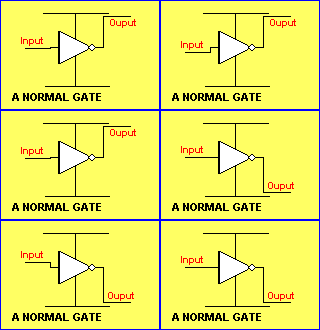
Fig: 10 shows the input voltage varying in this intermediate zone and the output fluctuating very rapidly:

Video Bokep Ariel Dan Donita

Even a fixed voltage in the intermediate zone will cause the output to fluctuate:

Video Bokep Ariel Dan Donita

This is due to the high gain of the amplifier in the gate and it does not know if the output should be high or low.  It is essential for the input voltage to pass through this zone very quickly to prevent the gate "oscillating."
The output will only fluctuate when the input voltage is rising slowly or sits in the zone, as it takes a short period of time for the gate to start oscillating. 
For this reason a normal gate is not suitable for low frequency (slow-rising waveforms).
The Schmitt gate does not have this problem. 
If the voltage on the input of a Schmitt Trigger rises very slowly, the output changes at 66% and it will only change back to its original state when the voltage drops to 33% of rail voltage. At no time does the gate self-oscillate. This is one of the advantages of the Schmitt Trigger. 

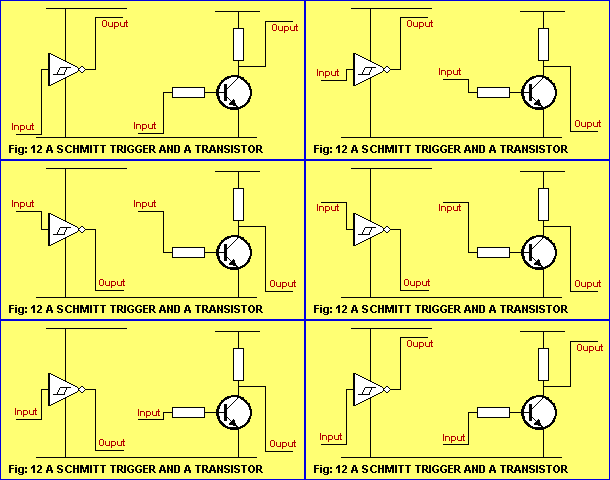
Fig: 12 shows how a Schmitt gate can be considered to be similar to a common-emitter NPN transistor:
Video Bokep Ariel Dan Donita

The similarity is only approximate and you can see the general operation of each circuit has some similarities. It is important to note that the two circuits cannot be interchanged without modifying the surrounding components. 

SWITCH DEBOUNCE
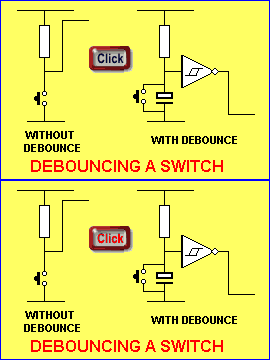
A Schmitt gate can be used to eliminate noise from a switch.  When any type of mechanical switch is closed, the contacts "bounce" due to the dirt and an oxide coating on the contacts and this puts noise on the line. Sometimes this noise is seen as additional pulses by high-speed digital circuits with the result of "false-counting." The Schmitt gate circuit below prevents multiple pulses from being passed to a circuit:

Video Bokep Ariel Dan Donita
Mouseover to see switch action

SIGNAL CONDITIONING
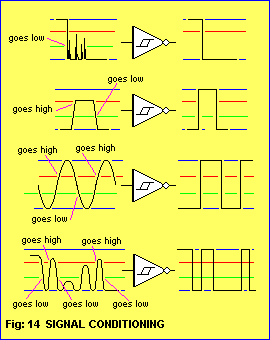
The Schmitt Trigger can be used to improve the quality of a signal by speeding up the rise and fall times. The rise and fall time is called the TRANSITION TIME. The Schmitt trigger will reshape a waveform into a square wave. 
It will also convert a SINEWAVE or ANALOGUE waveform to a SQUAREWAVE. 
Any form of improving a signal to a square wave is called SIGNAL CONDITIONING
This is also called RISE-TIME improving. The Schmitt Trigger produces a fast-switching digital output suitable for edge triggering.
Fig: 14 shows waveforms improved by a Schmitt Trigger.  Only excursions above 66% will appear in the output:

Video Bokep Ariel Dan Donita

SWITCHING THRESHOLD 
The SWITCHING THRESHOLD is the point where a signal changes logic states. 
A Schmitt Trigger has two thresholds - or TRIP POINTS. A positive going threshold (Vt+) and a negative going threshold (Vt-). 
The positive going threshold is also called the UPPER THRESHOLD and occurs at 66% of rail voltage. The LOWER THRESHOLD occurs at 33% rail voltage. 
The difference between the two thresholds is called the HYSTERESIS ZONE.
A signal will not change the state of the gate until it passes the positive going threshold. A high signal that enters the Hysteresis Zone will not change the state of the gate until it reaches the negative going threshold.
Besides preventing unwanted oscillation, the Hysteresis Zone also provides noise immunity.

THE 4093 IC
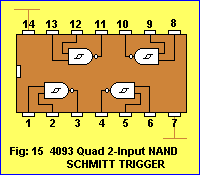
Another common Schmitt Trigger IC is the 4093. This is a Quad 2-Input Schmitt Trigger.

Video Bokep Ariel Dan Donita

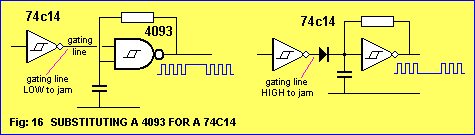
The CD 4093 is sometimes used for its gating capability. One of the inputs of the gate can used to turn the gate on and off.  This is called GATING. This feature can be achieved with a single-input Schmitt Trigger with a diode. This allows the 74c14 IC to be used. 
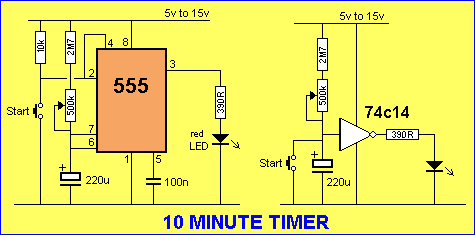
Fig: 16 shows how to substitute a 4093 NAND gate for a single-input gate:

Video Bokep Ariel Dan Donita


SUBSTITUTING THE 555
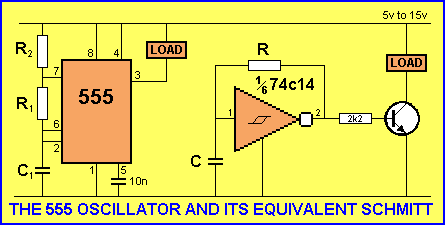
The 555 can be replaced by the 74c15 in almost every case, with the advantage of lower quiescent current and the availability of 6 building blocks. The 74c14 Schmitt gate is comparable with the 7555 (the CMOS version of the 555).
Fig 17 shows a 10 MINUTE TIMER. The circuit is also called a DELAY circuit:

Video Bokep Ariel Dan Donita

The 555 replaced by a Schmitt gate and a transistor to provide the drive-current:
Video Bokep Ariel Dan Donita


SUMMARY
A Schmitt Trigger is a bistable (two-state) device used to square-up waveforms with slow rise and fall times. The most common applications are THRESHOLD DETECTION and SIGNAL CONDITIONING. Speeding up the TRANSITION (rise and fall) time affects the shape of the waveform, turning poor signals into reliable waveforms capable of driving digital ICs.
The THRESHOLD DETECTION feature will prevent signals with insufficient amplitude (such as noise) from activating the clock lines of digital chips.


See Page 76 for more discussion on the Hex Schmitt Trigger

NEXT page of this course

Video Bokep Ariel Dan Donita